
Why Sustainability Often Feels Harder Than It Should
Many businesses want to operate more sustainably, but aren't always sure where to begin or which actions will have the greatest impact. Big sustainability goals may be set, but turning them into everyday actions can feel daunting — making initiatives feel abstract or disconnected from daily tasks and decisions.
Sustainability Is an Operational Issue
It's actually everyday operational decisions, not one-time initiatives, that often have the biggest impact on meeting sustainability goals. Facilities, IT, and operations teams can influence sustainability through choices about equipment and devices, materials and consumables, and how energy is used throughout the day.
Over time, these decisions add up — quietly shaping energy use, waste, and environmental impact across an organization. In short: sustainability can't be viewed as separate from operations. It needs to be built into how work gets done, day in and day out.
How Everyday Decisions Add Up
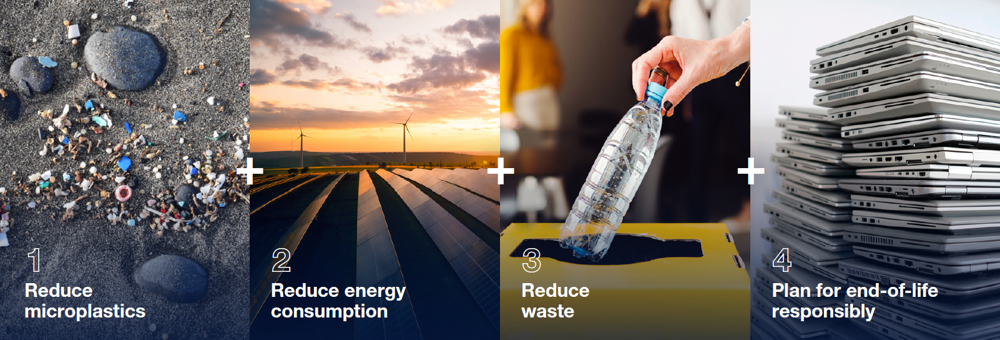
When repeated across rooms, floors, and facilities, the impact of small operational choices compounds over time. Everyday technologies, including printing, influence electricity use, waste, and indoor environmental quality. Looking at sustainability through this operational lens reveals four focus areas where organizations can take practical, meaningful action:
- Reduce microplastics
- Reduce energy consumption
- Reduce waste
- Plan for end-of-life responsibly
1. Reduce Microplastics
When we think of microplastic pollution, we usually envision oceans and waterways. But microplastics also exist in everyday indoor environments. In workplaces, they can come from common materials and furnishings — like synthetic carpets, upholstery, and packaging — as well as everyday technologies. These particles are often invisible, which makes them easy to overlook.
Reducing microplastics doesn't require sweeping changes. In many cases, it starts with paying closer attention to what's purchased and used across the workplace.
How Organizations Can Act Today
Look closely at everyday materials
- Consider where microplastics can show up: flooring, furniture, textiles, and packaging can all shed microplastics.
- Choose for longevity: favor durable materials designed to last and wear less.
Consider how the equipment operates
- Pay attention to mechanics: many technologies rely on heat or mechanical friction, a key driver of microplastics — for example, laser printers that emit plastic particles during high-volume printing.
- Look for lower-impact options: lower-heat, lower-friction technologies can help reduce impact over time.
Key questions to ask vendors about materials:
- What materials are used, and how do they break down with use?
- How is environmental impact considered across the full lifecycle of materials and equipment?
- Are there alternatives that reduce mechanical friction and therefore particulate release?
2. Reduce Energy Consumption
Discussions about energy efficiency often focus on how buildings are constructed, along with lighting and HVAC systems. But the devices and equipment used every day also contribute significantly to energy consumption — especially in offices where shared technologies can run for long hours, even when they aren't actively being used. This is especially true for heat-based processes, such as certain types of printing.
How Organizations Can Reduce Energy Use
Look beyond peak energy ratings
- Remember, consumption is continuous — it doesn't just happen during active use.
- Account for idle, standby, and warm-up energy throughout the day.
- Evaluate how equipment behaves across the entire workday, not just at full capacity.
Choose technologies designed to operate at a lower temperature
- The higher the operating temperature, the more energy required.
- Lower-heat performance can reduce electricity consumption immediately.
Match equipment to real-world use
- Avoid overbuying devices that exceed your organization's actual needs.
- Right-size equipment to reduce both energy use and operating costs.
- Consider consolidating or upgrading outdated equipment to improve efficiency.
Key questions to ask vendors about usage patterns:
- How often does it warm up or cool down during a typical day?
- Does this equipment rely on a high temperature to operate or reset between tasks?
- What does energy use look like in stop-and-start environments like offices?
3. Reduce Waste
Waste in the workplace isn't always obvious. Beyond paper, a significant amount comes from equipment, consumables, packaging, and replacement parts. When technologies have short lifespans or require frequent maintenance, replacement — and waste — becomes routine.
How to Choose Longevity Over Waste
Look at the big picture
- Track what gets replaced most often, since frequent replacement increases waste over time.
- Choose solutions designed to use fewer consumables or require less frequent replacement.
- Think long-term: consider total usage over months and years, not just immediate needs.
Consider long-term durability over short-term savings
- Be cautious of low upfront costs, which can sometimes lead to higher long-term waste.
- Durable, well-designed equipment can reduce the need to swap parts or re-order supplies.
- Longer service life often aligns with both sustainability and cost-efficiency goals.
Reduce waste through smart planning
- Match equipment to real usage needs rather than purchasing "just in case."
- Avoid overbuying or deploying unnecessary devices across teams and sites.
- Consolidate where it makes sense and time upgrades to reduce unnecessary disposal.
Key questions to ask about durability and maintenance:
- How often does this equipment require replacement parts or servicing?
- What consumables are needed — filters, cartridges, liners — and how frequently are they replaced?
- How does maintenance impact waste over the life of the product?
4. Plan for End-of-Life Responsibly
Sustainability decisions start the minute you decide to acquire something new. End of life — reuse, recycling, or responsible disposal — can have a major impact on waste, cost, and overall environmental footprint. Proactive end-of-life planning supports sustainability goals and improves long-term operational efficiency.
Plan Ahead to Reduce Waste Later
Plan end-of-life early
- Build disposal, reuse, or recycling into procurement at the time of purchase.
- Choose equipment designed with longevity and responsible end-of-life in mind.
- Avoid solutions that make reuse or recycling difficult.
Extend useful life wherever possible
- Regular maintenance can extend equipment lifespan.
- Upgrade strategically to reduce unnecessary replacement.
- Reuse or redeploy equipment when it makes sense.
Align end-of-life planning with operational goals
- Coordinate across facilities, IT, and sustainability teams.
- Track equipment age and replacement cycles.
Key questions to ask vendors about end-of-life:
- What options exist for recycling or take-back at the end of its life?
- Are materials clearly labeled?
- How does the vendor support responsible disposal or refurbishment?
Put Sustainability Principles to Work
Sustainability principles only create impact when they're applied to real operational decisions. The same questions organizations ask about materials, energy, waste, and end-of-life apply across many everyday functions and systems. One of the most common — and often overlooked — places these principles come together is printing, a core function in many workplaces.
How to Make More Sustainable Printing Choices
Considering sustainability in printing often means printing less, when possible, and smarter:
- Favor technologies that consume less energy.
- Reduce reliance on frequent consumable replacement.
- Choose durable equipment designed for longer service life.
- Plan printing decisions as part of broader operational sustainability goals.
In many cases, the biggest difference comes down to whether printing technologies are designed to reduce energy use, materials, and waste at the source, rather than compensating for inefficiencies later.
What Sustainability-Driven Design Looks Like
With a decades-long commitment to sustainability, Epson has embedded environmental responsibility into its printer and copier product design. Epson Business Inkjet printers, powered by PrecisionCore® heat-free technology, reflect a design philosophy focused on addressing sustainability through how printing is engineered — not after-the-fact workarounds — without sacrificing productivity and reliability.
Most business printers and copiers operating today use laser printing technology, and users are often unaware of what happens inside their device, or that there is a more sustainable way to print. As part of its commitment, Epson made the industry-leading decision to discontinue selling laser printers and focus on inkjet innovation designed with sustainability in mind from the start.
There's a Better Way to Print
For all Epson business inkjet printers, PrecisionCore® Heat-Free technology is designed to help reduce energy use, materials, and waste at the source by eliminating the need for heat in the printing process.
Toner-free
Epson business inkjet printers use zero plastic toner powder.
No warm-up required
Heat-Free technology supports fast first page out with no warm-up.
Less waste
Up to 53% less waste with the Epson WorkForce Enterprise AM-C5000 vs. color laser printers.*
Low power consumption
Save up to 86% on electricity with the Epson WorkForce Enterprise AM-C5000 vs. color laser printers.*
Your Sustainability Checklist
Use this checklist to start applying these sustainability principles to your everyday operational decisions.
DownloadReducing Microplastics
Reduce microplastics by improving filtration, choosing low-shedding materials, and opting for toner-free printing.
- Inventory common sources: Identify high-shed materials in your workplace (flooring, furniture, textiles, packaging).
- Build vendor questions into purchasing: Ask how materials break down with real use, not just lab specs.
- Evaluate equipment mechanics: Flag technologies with a high operating temperature or that rely on heat, and explore lower-impact alternatives.
Improving Energy Efficiency
Save energy by using heat-free and LED technology, efficient HVAC, and power-smart equipment.
- Evaluate full-day usage: Review energy use beyond peak ratings, including how devices behave throughout the workday.
- Account for "in-between" energy: Include idle, standby, and warm-up energy in stop-and-start office environments.
- Ask about heat: Confirm whether a technology requires heat to operate.
Reducing Waste
Reduce landfill waste through recycling, reusing, bulk purchasing, and avoiding high-waste devices.
- Track replacement drivers: Identify what gets replaced most often (consumables, parts, packaging, components) and why.
- Choose for durability: Prioritize longer-life solutions that reduce replacement cycles and maintenance needs.
- Right-size and consolidate: Match equipment to real usage needs and avoid deploying unnecessary devices.
Planning for End-of-Life Responsibly
Ensure equipment and furniture are reused, refurbished, or recycled responsibly through certified programs and nonprofits.
- Plan end-of-life at procurement: Confirm reuse, recycling, and disposal options before purchase, not after.
- Confirm take-back and recycling support: Ask vendors about take-back, recycling, refurbishment, and reporting options.
- Align teams and timelines: Coordinate facilities, IT, and sustainability teams on refresh cycles and disposal plans.
Tip: Look for technologies designed to reduce energy use, materials, and waste at the source, not compensate for inefficiencies later.
Ready to Rethink Your Printing?
Learn MoreThis blog was originally posted on www.epson.com. EPSON is a registered trademark of Seiko Epson Corporation. All other product and brand names are trademarks and/or registered trademarks of their respective companies. Epson disclaims any and all rights in these marks. Copyright 2026 Epson America, Inc.